
I was born in Milwaukee, Wisconsin, and lived there until I was about seven years old. My mother was a single parent and a certified K–8 teacher, and much of my childhood was shaped by her search for stability and opportunity for our family. We moved to North Carolina for several years before returning to Milwaukee, where we stayed with my grandmother while my mother rebuilt. When I was sixteen, we moved again, this time to Oshkosh. Because of these transitions, I grew up learning how to adapt quickly to new places, schools, and people. I became someone who could blend in anywhere, not because I wanted to disappear, but because survival required flexibility. That instinct to observe, listen, and adjust has deeply shaped both who I am and how I work as an artist.
Moving to Oshkosh was a turning point. I went from a predominantly Black environment to a community where very few people looked like me. The culture shock was immediate. I had to navigate spaces where I stood out and wasn’t always sure how to be understood. Around this time, I bought my first camera. What began as casual photos of friends, skaters, fashion, and daily life grew into something much deeper. The camera became a social bridge and a source of confidence during a period when I felt uncertain about where I belonged.
By my junior year of high school, photography had become central to my identity. I wasn’t the strongest student academically, but I was deeply committed to making images. In a place where I often felt like an outsider, photography gave me purpose and visibility. Being “the photographer” allowed me to move between groups and environments in ways that might not have been possible otherwise.
Today, photography remains both a creative practice and a way of moving through the world. My work centers on people and their stories — their struggles, resilience, and humanity. I am drawn to what exists beneath the surface: the emotions, histories, and contradictions that do not immediately reveal themselves. I grew up surrounded by strong women — my grandmother, my mother, and now my sister — and I am especially committed to documenting everyday strength that often goes unseen.
Two of my proudest accomplishments as a Wisconsin artist are creating “Who’s Next Door,” an interactive multimedia portrait and audio interview installation in downtown Appleton sponsored by the Trout Museum of Art, and acting as the contributing portrait photographer for Somali-American poet Sadia Hassan for the inaugural issue of the UW-Whitewater annual literary journal, “Either/Or.”
I work in both digital and analog photography, though film holds particular meaning. Its slower pace demands intention and presence. In the darkroom, I reflect not only on the images but on my own growth. Ultimately, I aim to create work that helps people feel seen — preserving stories, building empathy, and creating connections across experiences.
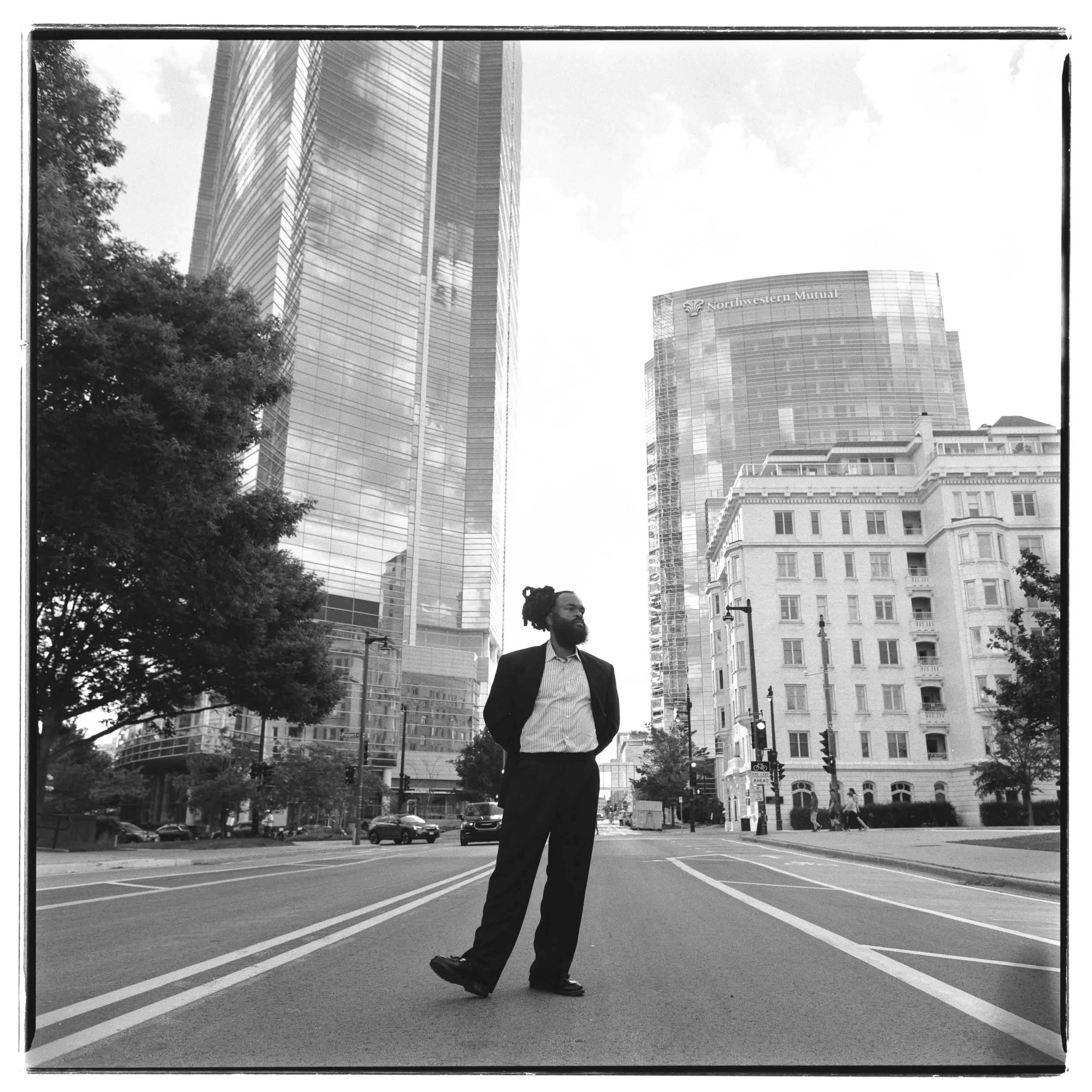
"My goal for this is to make a history capsule for my people, whether it's people my age, whether it's the elders. Mainly it's giving the elders a platform to tell their story."
A Fruit to a Seed is a multimedia documentary project documenting Black Milwaukee through its historic buildings and the elders who remember them. The project focuses on places and stories that are often overlooked, preserving the traces of Black life, work, and community that remain. The title reflects the idea that the past grows into the present. The buildings and voices documented are like seeds carrying memory forward.
This project has two main components. First, I will photograph surviving buildings with historical significance to the Black community across Milwaukee using both a 4×5 view camera and medium-format film cameras. These buildings include churches, businesses, social halls, schools, and homes that were historically central to Black life in Milwaukee. The photographs will capture architectural details, textures, and presence, creating a cohesive body of work that emphasizes the unifying role that physical spaces played in creating community and culture. By photographing each building slowly and intentionally, I aim to reveal the character and history embedded in these structures and convey how physical memories from the past can not only teach younger members of the Black community about their own history, but play a valuable role in helping them to understand their present lives.
Second, I will photograph portraits of Black elders in Milwaukee and conduct audio interviews with them. These conversations will explore their life histories, experiences in Milwaukee, and memories connected to the neighborhoods and buildings in my photographs. The photographic portraits will accompany the interviews, showing the elders as living witnesses to the community’s history and highlighting their personal connections to the spaces documented.
Each photograph will be paired with short notes drawn from the oral histories and archival research, linking the physical buildings to the people who lived and worked in them. This combination of images and audio will create a layered record that connects place, memory, and lived experience. The project captures both what remains in the city and the stories that give these spaces meaning.
A Fruit to a Seed is a project of preservation, visibility, and storytelling. It documents the architecture and people that carry the history of Black Milwaukee, affirming their resilience and contributions. The work will create an archive for community members, researchers, and future generations, ensuring that the stories of these buildings and elders continue to be recognized and remembered. By combining photographs and oral histories, the project provides a fuller, richer view of Black life in Milwaukee, making visible what has too often been overlooked.
Through careful observation, intentional photography, and the voices of elders, A Fruit to a Seed honors the past while building a foundation for memory and understanding that can grow into the future.